
Dates
Opens May 24The film takes up residence squarely in Maisie’s perspective, opening with a series of scenes that spy bitter parental arguments from around the corners of the family’s white-walled, modernistic multi-storied New York flat.

The film takes up residence squarely in Maisie’s perspective, opening with a series of scenes that spy bitter parental arguments from around the corners of the family’s white-walled, modernistic multi-storied New York flat.

Jared Moshe’s directorial debut, Dead Man’s Burden, is a steady-handed western, a plodding, straight forward fable that draws more from the John Ford tradition, than Sergio Leone’s.

If the name of actress Trine Dyrholm brings to mind the sparse and cerebral (and groundbreaking) style of Dogma 95, then seeing her name on the marquee for the new film Love is All You Need might come as a shock.

Oak Cliff isn’t the only Dallas area community with its own film festival. The Dallas Film Society has teamed up with the Highland Park Centennial Committee to launch the Highland Park Film Festival.

It’s exciting watching the celebrity commentary pile up — Giorgio Armani; Patricia Field, the Sex and the City costume designer; Vogue contributing writer Lynn Yaeger; Jason Wu, etc. — until you realize they’re all performing the same cheerleading routine. And why would they do otherwise? It’s clear that Bergdorf Goodman is not a store you want to disappoint. Or, as designer Isaac Mizrahi puts it, “If your clothes are not at that place, then they have no future.”

The new documentary Koch tries to put New York’s famous mayor’s legacy in perspective. It is an affectionate, but by no means a fawning biography.

The early praise that J.J. Abrams’ new Star Trek is receiving is an indication of just how low our expectations have sunk for the summer blockbuster.

Highlights of the second annual festival include a few anticipated films from the festival circuit, shorts showcases, Robert Altman and Terry Southern, and bicycles.

Say what you want about Baz Luhrmann’s busy, caustic, cacophonic, messy, indulgent, slapstick, adaptation of The Great Gatsby. The director is at least trying to make Fitzgerald’s novel feel new.

If you are familiar with the work of director Ramin Bahrani, then his new movie will surprise you, not least because Bahrani has exported his talent from the East Coast to Iowa.

The adaptation of Salman Rushdie’s Midnight’s Children is visually rich and sporadically entertaining, but something is lost in the translation from page to screen.

The idea of the hippie commune — idealist, utopian communities founded in a haze of exuberant mysticism, doting guru fidelity, and marijuana smoke – likely conjures up vague generalities: white robes, white-eyed meditation sessions, alfalfa sprout diets.

“We’re not survivors. We’re fighters. We fought,” wrote Esther Stermer years later about her family’s struggles during the Second World War. I’d never thought of that distinction before in regards to those who suffered the horrors of the Holocaust, but there’s no doubt that that’s what many of them did. They fought for their lives.
Generations of the Stermers and a few dozen others Jews of a small Ukrainian village spent more than a year during the conflict living in underground caverns to hide from the occupying Germans and avoid being carted off to concentration camps or gas chambers. There was little food and water available, at times almost none. They spent days at a time in complete darkness, only a few of them ever able to risk venturing to the surface to obtain whatever provisions they could beg for or steal.

Our story resumes not long after the events of last year’s summer blockbuster, The Avengers. Having helped save the world from an alien invasion by flying into a wormhole, our hero Tony Stark (Robert Downey Jr.) is suffering post-traumatic stress disorder. He’s having anxiety attacks and is unable to sleep, due to nightmarish flashbacks. Instead he spends most nights in his workshop, tinkering with new designs and features for the armored suits that transform him into Iron Man.

In The Reluctant Fundamentalist, Mira Nair (Monsoon Wedding, Vanity Fair) ties to construct a scenario that would drive even the most successful and promising Muslim-born, American sympathizer to extremism.

A Neapolitan fishmonger gets a call back from the Italian version of the Reality TV show “Big Brother,” and it is enough to uproot his connection to, um, reality. Wordplay aside, Matteo Garrone’s film is an exasperating, astute, and befuddling contemporary parable that weaves the desperate story of a pitiful everyman into a rumination on life, dreams, media, aspiration, and even the nature of religious conviction.
Garrone is one of my favorite Italian directors working today, in part because he excels in a kind vernacular cinema, one that is thick with its regional sense of place. Reality is a particularly Italian film in the way it sets its critical sights on a national infatuation with status, wealth and prestige (some of the reasons why the successful playboy Silvio Berlusconi was reelected so many times). The film’s opening sequence is particularly strong, with Garrone’s camera gliding through a wedding scene. Perhaps the director is poking fun at The Godfather, the way cinema creates negative ideals (the Italian success story as criminal underworld), but it doesn’t take long for us to realize that this bourgeois wedding scene has been turned on its head, transforming it, through a subtle shift of perspective, from a vision of regal grandeur to crass contemporary kitsch. It’s part in parcel with the way Garrone sees the world, a place of deception, manipulated by forces both exterior and interior to ourselves.

The Renoir that Gilles Bourdos lush and sultry historical drama revolves around is the painter, Auguste (Michel Bouquet), whom we meet at the end of a career, as he struggles with physical ailments. The Renoir who holds our attention is Jean (Vincent Rottiers), the future filmmaker who is a young man released from military service. Back at his father’s villa he meets the fetching nude model Andree (Christa Theret), a satyr of sorts, whose precocious sexual sense is an agent of maturity. Bourdos’ film is best as a visual feast, so rich with color and exquisite light, but its romance and familial subplots meander a bit before they diffuse into a sloppy ambiguity.

D Magazine editorial intern Farraz Khan wants to give you a full re- introduction to the much-maligned and misunderstood cinema of Bollywood.

Mud’s river-bound universe offers that peculiarly southern literary blend of the transcendental and the infernal.

Have you ever read a news report about some poor couple who suddenly find themselves the parents of sextuplets or octuplets or some similarly litter-sized brood, and thought how horrible that must be for them? Well, imagine then what it might be like to discover suddenly that you are the father of 533 children, and you’ll have some sense of the predicament that faces the man at the center of the French Canadian comedy Starbuck.
His name is David Wozniak (Patrick Huard), and he’s a shiftless loser who only manages to keep his job delivering meat for a butcher shop because his father owns the place. In his 40s, his wardrobe seems to consist mostly of sports-related T-shirts, and he pursues get-rich-quick schemes that leave him heavily in debt to some sketchy characters.
He learns that a sperm bank to which he donated for cash more than 600 times almost 25 years ago apparently used his specimens for all of its clients. Not only that, but some 142 of his progeny have filed a lawsuit asking that the identity of their biological father be revealed. This shocking news comes shortly after he’s also impregnated his girlfriend, his first child conceived the old-fashioned way, and has vowed to become a good father.
Frightened by what these hundreds of kids might want from him, he enlists his lawyer-friend (Antoine Bertrand) to argue to the court that his anonymity (his donations were made using the alias “Starbuck”) be protected. But, in the meanwhile, he begins to learn more about his children, almost all of whom are in their early 20s. When he discovers one of them is a well-known professional soccer player, he attends a match and beams with full paternal pride after his son scores a goal. The experience gives him a taste of the upside of being a dad, and he becomes addicted to tracking down each of the others without revealingly to them who he is.
It’s the best part of the film, as David helps an aspiring-actor son land the audition of a lifetime, saves the life of a heroin-addicted daughter, and visits a severely physically disabled son in a nursing home, among others. These scenes are alternately comic and movingly dramatic. The film does a wonderful job of exploiting its premise to suggest how David is getting a crash-course in fatherhood, both the highs and the lows. I could have watched many more of these moments, or even imagine how this idea might be turned into a TV series, about a man wandering from town to town getting involved in the lives of strangers (who just happen to be his kids), like a variation on Highway to Heaven or The Fugitive.
His new hobby gets disrupted somewhat when one of his sons discovers his identity and demands that he be allowed to stay with him for awhile, in exchange for keeping the secret. This eventually leads to David finding himself at a weekend picnic surrounded by all the kids who are party to the lawsuit, where he’s able to revel in their company even as they don’t realize who he is.
Starbuck becomes less interesting once it shifts from these interactions with the children to the resolution of its courtroom plot. I wish these legal maneuvers, and the subplot involving David’s debts, had been discarded entirely in favor of a straightforward story about his personal growth.
Still, there’s more than enough charm in the movie, and it’s easy to see why it has already been remade by Dreamworks with Vince Vaughn in the title role (called The Delivery Man, it’s slotted for a release this fall). I think Netflix or HBO should give serious consideration to turning it into a TV series too.

If you’re not interested in a movie that’s far more lyrical than narrative, if you’re uncomfortable with actors portraying philosophical constructs rather than fully fleshed characters, if you’ve only sat through one of Malick’s earlier films as some sort of sadistic endurance test, then you’re better off skipping To the Wonder.
As for me, until the last couple years, I’d had mixed feelings about the filmmaker. I thought Days of Heaven was overrated. I liked The New World well enough. His World War II film, The Thin Red Line, was awfully dull. But then came 2011’s The Tree of Life, a masterpiece and the best movie of its year.
After such a grandly ambitious work, which placed the story of an ordinary 20th-century American family in the context of the meaning and history of the cosmos (and, yes, included dinosaurs), To The Wonder feels much smaller in its outlook. It too ponders the nature of human existence, but it’s even more explicitly focused on a single aspect: love.

From the film’s very first scene, in which Sofia and Malcolm stuff cans of spray paint in their shorts and shirt and dash out of a convenience store, Gimme the Loot proves a zippy, irreverent, endearing, and perfectly paced thrill.

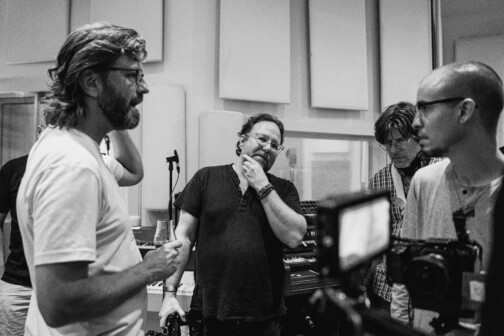
This kicks-off a new conversation series discussing art and culture. We take advantage of the many April film festivals in Dallas to discuss Dallas filmmaking with PIT STOP director Yen Tan, producer Eric Steele, and actor and screenwriter Steven Walters.

Almost a decade after he took Sundance by surprise, the director of Primer finally returns with an intriguing new film.