In reading the responses to the Creative Time SMU Meadows report, we thought it would be helpful to add some context and clarity by defining our process during our Meadows residency over the past year. Creative Time may be best known for producing public art projects in New York City, but we also produce projects across the nation and now globally. In addition to our projects, we have an advisory service that has worked with various cities around the country to develop civic art programs and master plans. When we were awarded the Meadow’s prize, it was suggested that we research the Dallas art community. Given recent conversations and debate around the health of the Dallas art scene, we thought this would be a great time to participate and contribute to the artistic advancement of this city.
There is an undercurrent to all the recent discussions held in conjunction with the Creative Time visits: who exercises cultural power? Repeatedly, the message that Creative Time communicated was: the artist. This reminds me of Ad Reinhardt’s brilliant complaint, where he asks: ‘Who is responsible for ugliness?’ If not the artist, then who?
One wonders if there is a single principle in the Creative Time report to which Dallas artists can subscribe without feeling that they are betraying themselves. There has been a lot of posturing going, most of which has been framed in crudest protectionist terms.
My thoughts on the SMU Meadows Prize Report is that most of what the report addresses is on target. I do think there is a lack of non-profit artist spaces but that the numerous university galleries take up that slack; though in an ideal world there would be plenty of both. The collectors are here and the artists are here but it would be, again, ideal if the collectors here were collecting more local and regional art. After all, many of the artists who have created the art now have national reputations. This is not to say that the collectors should stop buying national and international artists at all. The Metroplex is one of the richest museum repositories of art in the nation but do they reflect the richness of the regional art scene? Art criticism is the most difficult because the major newspapers are relegating arts writing to human interest and not criticism. Yet, they have movie reviews, why not art reviews? The readers could demand that the newspapers return to having a more extensive arts coverage. Thank goodness for A+C, Art Lies and Glasstire; but then again, there could be more.
One area that did not get addressed is the diversity of the art community. I feel that there could be more diversity not in the artist ranks, because it already is diverse, but in other facets of the community. Look at the roster of artists in commercial galleries, the curators of the museums, the university gallery directors. Not much diversity there. And as for collectors – what they collect usually reflects what they see in any of those categories. The Museum of Fine Arts in Houston has an African American Collectors Circle. They also have a Latin American curator (thought Latino, Chicano and Mexican American art is not her focus – and yet those categories I just mentioned are all American art). This is a big problem, and here it is the 21st century.
There are two factors that work against the Metroplex having a more cohesive art scene. One is geographical. Because the Metroplex is just that — a cluster of cities small, medium and large — it makes it physically difficult for that daily interweaving of artists from each of those communities. And speaking of interweaving, there could be more of a woven community between artists, gallerists, curators and collectors. The museums and non-profit artist spaces could be the conduit for such gatherings. The Rachofsky House does an artist night there, but imagine an art night like a museum mixer where all of those factions come together. Perhaps there ideas could get formulated, discussed, exchanged and later, even, realized. This would make for an even more exciting art scene in the Metroplex.
I was interested to read the Creative Time report, and to follow the response. At one level, the report is inarguable. You can’t take issue with any of its recommendations. At another level, the report’s approach is highly particular, even pointed. It suggests that transformation will follow less from a great new project, a bold new vision, a new or restructured institution, or even the focused application of resources. Rather, we’ll attain the goal of a thriving artistic community through the progressive accretion of simple, obvious, positive behaviors. If we can, each of us—administrators, artists, collectors, gallerists, journalists, trustees, educators—be better arts citizens, then our arts community will thrive.
To a city that’s just witnessed the completion of dazzling new cultural edifices and the assembly of extraordinary art collections, the Creative Time approach might appear prosaic. Instead of the excitement of a grand vision, Creative Time offers a series of modest steps. Rather than the satisfaction of reading what other people should do, and how they should spend their money, we’re told to do it ourselves. And while it might be fun to see fingers pointed (not at ourselves), what’s fun about being told to cook dinner?
I’m trying to put myself in the shoes of Creative Time, considering “what” and “how” I would present to a city’s art community that seems to be looking for a road map to success but didn’t fully ask for my help. Many voiced the observation that the report is vague and too polite. I guess the report could have revealed more of the dirt learned in private conversations and called it as the reporters inevitably saw it, leaving Dallas to confront and fight out the resentment it has been harboring. While I know this report addresses the need for concrete things like a real art writer for the Dallas Morning News and collectors looking for art at home as well as from “art centers” elsewhere, I think many of the reactions to the report are actually reactions/responses to each other and ourselves. But I do agree with Christina Rees and others that the report should have been more rigorous, as well as with Ben Lima that the advice should have and could have been specific to the region. Which brings me to another point; Dallas can only realize its potential by recognizing that it isn’t an island but rather part of a metroplex. Businesses and families may have reasons to draw the city limits with a permanent marker and fuel rivalries but the art community doesn’t. There is no competition. The drive from Dallas to Fort Worth and Fort Worth to Denton, etc is not overwhelming and completely worth it to strengthen the community as a whole or just to take advantage of some incredible opportunities. After driving to Fort Worth to see an exhibition or for a lecture, artists and the like should organize dinner or drinks at one of the restaurants or bars within walking distance of the museums or within a 7 min. drive. Discussions over food and drink following something stimulating like a lecture or seeing art are where ideas form and plans are hammered out. Denton and Arlington have the same to offer. Some of you know I’m right because it’s what you do. Such conversations have been organized for us but we need to make it a personal practice. There shouldn’t always have to be an agenda. It’s what I do when I go to Dallas and I consider myself fortunate to have the opportunity. I also think there’s a need to spend more time actually looking at and thinking about art for our personal well being. We don’t have anything to talk about or present to the world if we don’t stay engaged with art which is what supposedly brought us to this report and its responses.
We have to individually be clear about what we want and why we want it. Making communities should be organic but sometimes we just can’t wait so we need to proceed knowing that anything forced is going to be messy.
[Ed note: Richard Patterson's response to the Creative Time report was originally submitted as a comment to Lucia Simek's response the report, which you can find here. It also addresses comments by Laray Polk that were made in the comments to Simek's piece. Patterson's response below has been reposted with some corrections and additions by the author.]
Well said, Lucia. The other simple issue is that we just need much more stuff in general – more of everything – and as you say, not any old stuff, but good stuff.
The critic’s voice is important for simply ‘being there’. It’s not an option to not be there, although somehow Dallas previously allowed it to be so. It is as much an integral part of the creative process as anything else, as anyone who has read FR Leavis will know. Art and criticism are not just bedfellows, they are the beast that makes two backs – the hairy, lairy, heaving, grunting, sweating, squirting, creaking, bed-collapsing, cigarette smoking, Belgian chocolate eating, lets go to Wholefoods now and then on to the Winspear….beast with two backs. It is the cultural ‘procreative’ process. I shag, therefore I am, etc. I eat Belgian chocolates afterwards, therefore I am – you name it… Can someone please write a decent novel in Dallas/about Dallas by the way. That might be bloody entertaining.
My reaction to the Creative Time report is almost synonymous to what I feel when my New Yorker in-laws come to town and trivialize everything they see – “Wow, isn’t this Deep Ellum trying to be Brooklyn,” or “Let’s go to the Stockyards and see some real Texas” or “Isn’t this Northpark fancy” – which is to say, I get pretty defensive. “Shut up, man,” I want to say, “and open your eyes. This place rocks. Let me show you how.” But everything inevitably comes up short in the eyes of someone from New York, or some legitimized place. And certainly, we that are involved in shaping culture in this town know, very well, the odds we are up against. Those odds just so happen to be the very things Creative Time pinpointed (as outsiders with doors to the inside) in its report.
My dukes are up.
I think that many of us wanted to see some very cool public art event take place as a result of Creative Time’s study. I was thinking an art flash mob down Flora Street. (Frances Bagley’s blind Zebra on the back of a truck parading through a silent, Biggest-Arts-District-in-the-World, anyone?) But that didn’t happen. Instead, the bland report kicked us in the pants with its duh-ness. Mr. Miagi, is that you dressed up as a bunch of art folks from up North?
Wax on, wax off…
We know this stuff. When do we learn how to fight?
I read the Front Row article and then the Report, complimented Noah, and then referred him to a new movie I just watched called Cool School about Walter Hopps, Irving Blum, Dennis Hopper and some other ambitious artists who created Los Angeles’ modern art scene from scratch back in the 1950′s. The Report mirrors several key elements in the movie’s principals’ plan and vision.
I am neither an artist nor a scholar. I am, however, very active in the local arts community, volunteering and sitting on committees and boards with the Dallas Museum of Art, Dallas Contemporary, KERA, KXT, TITAS, Crow Collection of Asian Art, UTD’s Artist in Residency Program: CentralTrak, and most recently, the Emergency Artist Support League (EASL). I’m also an Ambassador to the Arts District. I spoke at Town Hall meetings when called upon to help save the Office of Cultural Affairs. I have a scheduled meeting with my City Councilmember next week to discuss the Public Art Program. I attend an average of at least 20 gallery openings a month on top of attending institutional events. I am out there.
Maybe the report is a vehicle, an annoying obstacle that makes people reflect in new ways. (Or, in the least, reflect in the unorchestrated company of one another.) Maybe our art community—The Community—is a fissile isotope that has been poked into activation by an outside force. Hopefully, a productive chain reaction will occur. And I think the potential exists if we are willing to open up. (It’s existence was there even before the report.)
There is a certain predictability of the criticisms and compliments of the report thus far: institutional v. individual momentum, people with means v. struggling artists, galleries v. the museum/classroom without walls, and local artists v. international artists. As a practicing artist, these are all too familiar crevasses of mind that we fall into over time (and it’s not unique to Dallas-Fort Worth). And we have the antidote with us at all times, but we forget. We imagine outside forces are controlling opportunities, and withheld opportunities are making our lives hell (which is, by the way, partially true). The reality is that creative imagination waits for no one; it is an activity that does not depend on a phone call, commission or favorable critique in the MSM to make experimentation and innovation happen (though it is certainly true those things can help pay for electricity or a dental bill which makes a studio space and one’s mouth a little less sufferable). The bottom line is that when many economies become intertwined in the business of making art, art making becomes a business of selling art (“art expertise,” catalogues, Tutty Bears and any number of ancillary items).
If the report points out anything we think we didn’t already know, it is that we live in a geography of vastness combined with very peculiar proxemics.That is what outsiders can bring to the equation that we can’t see even though it is right in front of us. We are socially challenged because of the peculiar proxemics (or vice versa). It is not for one individual, nor an outside collective, to say what all that involves. It would, though, make for an interesting discussion out in the open without declared moderators or institutional guidance or even an agenda of any kind. It is worth contemplating why the report angers us or makes us think that the ideas contained within it are going to change things for the better.
As several critics have noted, it seems that many of the recommendations in the Creative Time report are the kind of good ideas that would be valuable in many different cities; they don’t explicitly claim to identify unique characteristics of Dallas. Furthermore, the report apparently does not prioritize its recommendations, or estimate their cost in time and effort. For an institution to respond to the recommendations, it will need to use its own judgment about what they cost and how achievable they are. I don’t claim any expertise here other than as an interested member of the public, but I would be most interested in ideas for what Dallas can do better than other cities can do. For example:
Doesn’t DFW have more Fortune 500 headquarters than almost anywhere else? Are these companies all engaged with the arts? A minuscule fraction of such a company’s donation budget could constitute a huge gift for an arts organization. Are all of these companies approached regularly with convincing visions? The presence of these companies is a huge advantage for the area. Might they be willing to give more to the arts than they do?
Real estate is much cheaper here than on the coasts. That means good value for studio space. Doesn’t this lure dynamic individuals who can spark larger movements? I know things like this are probably already happening, but: What if a grant-making organization offered prizes of months- or year-long free studio space to top national and international art-school graduates who might otherwise go to New York, Los Angeles or Chicago? (More recent graduates will be less established and committed to another place, and more open to moving somewhere new.) The cost of such a program would be a small fraction of doing so in one of these other cities. Dallas has many real-estate developers. They could sponsor this cheaply and get a lot of free good publicity out of it. (Think of “The Andres Brothers Studio Fellowship” or “The Trammell Crow Studio Fellowship.”)
(This one shared with other Texas cities.) We border the South, the Midwest, and Mexico; also, migrants from the rest of the country, including the North and West, continue to pour in (four new seats in Congress, right?). This means concrete experience with diversity that many other places don’t have. These themes of diversity and change are of great interest to the rest of the country. Shouldn’t Dallas be in a good position to explore these issues in a way that attracts broad attention?
Also:
Many civic leaders seem to recognize the value of the “official” art institutions, i.e. the Arts District, but not as much the “unofficial” scene that arises when a critical mass of entrepreneurial, creative people start small-scale institutions on their own. This type of scene is what draws creative types to Austin, Portland and Brooklyn (and here too; see Jim Schutze on the ‘bikos’ of Oak Cliff). Of course the paradox is that these scenes thrive without official sponsorship. Maybe all the “official” institutions can do is to get out of the way. But there should at least be a good communication channel. The number of people who make such scenes happen is not large. Some of them have already commented on this report. Is there a network, an e-mail list, a way that these people can make themselves heard to civic leaders? Maybe there are bureaucratic or other things that can be done to help these people do what they do. At least the “official” institutions need to recognize the value of the unofficial institutions in attracting an interested public to the city.
We could discuss the value of prizes and contests in stimulating a huge amount of activity, sometimes more so than grants that fund operations. Examples include the Netflix Prize and the X Prize. Cash prizes basically get a lot of people to work hard for free in hopes of winning, and attract a lot of publicity. If Dallas institutions want a lot of bang for the buck, they could announce a prize or two, and see what flourishes. It looks like the Meadows Prize is a good example of this. (Here are a couple of articles from Slate that discuss prizes:
http://www.slate.com/id/2229225/
http://www.slate.com/id/2182663/

Just into the first four words of the Creative Time thirteen-item list, “Foundations for Success” I suddenly felt queasy. The room got all wiggly and blurry around the edges like on Letterman, and that phrase they used echoed inside my head.
“A sustainable artist community…community…community…”
I was having a flashback. To April, 2007, when I attended a forum sponsored by the Dallas Art Dealers’ Association. Moderator Thomas Krähenbühl of the Dallas firm TKTR Architects opened by reading a similar phrase from a similar list, from an article named something like Creating Great Cities for Art. Afterwards I tried to get the exact title, but by then I’d already stepped on the toes of panelists and organizers and it was too late, I’d burned my bridge.
(I do remember the name of the event, though. It was “How Important Are We: Dallas Fort Worth: The Next New York City?” Regarding that title, even panelist Charles Dee Mitchell later wrote on Glasstire, “I think all the participants had at one point considered just answering, ‘No,’ and letting everyone go home early.”)
My own faux pas was asking representatives of the Dallas Museum of Art, not in an entirely challenging way, if the institution was making any effort on their own to help foster the aforementioned artists’ community. They huddled briefly like contestants on Family Feud. Their final answer? The DMA’s general-admission, Free Thursday Nights!
ERRRRRNKKKKK. Wrong answer.
I’m an artist myself and so have every reason to want Dallas to develop as a cultural center. Now both the DADA panel and the Creative Time report have flagged as a key factor the need for a thriving community of local artists. Since nobody seems to be acting on that, it seems to me the advice is much more difficult, or less fun, to engineer than what we’re putting our effort into right now. And that’s where I have issue: with those who give lip service to these studies and reports and articles, saying they’re important; and who might even cite Richard Florida’s books on the Creative Class for their own purposes; but who in the end still ignore all that and revert solely to the Daddy Mallbucks throw-money-at-it, build-Pritzker-Prize-winning-architecture approach.
So what answer would I prefer the DMA had given at that DADA forum? It’s right there in the Creative Time report, under Key Factor No. 2 (Cultural institutions with international reach, innovative programs, and historically relevant collections), the second recommendation:
“Involve the local artist community. Include local artists in your exhibition program, hire artists to work at the institution, invite local artists to exhibition previews, and host artist happy hours and professional development workshops.”
What the DMA could do is foster relationship with artists, simply because they are artists, and not view them as just another segment of the Museum’s general audience. They, or any other Dallas arts institution, could accomplish this by acknowledging their common ground. You wouldn’t believe how many artists would value the connection. And you wouldn’t believe the little effort required to make more of them want to stick around Dallas and do their part in making it the “world class” art city Creative Time claims so many of us as want it to be.
It was unfortunate on that day in April of 2007 that the question getting the most attention was why artists in attendance weren’t getting their own exhibitions at the Dallas Museum of Art. Believe me, nobody wants that. And the active ingredient in the Creative Time prescription has nothing to do with exhibitions, sales or in any way anything to do with money. It’s all about the connection.
I agree, and this is not just another artist crying out “Poor little me! Won’t someone help me achieve my dream? DMA? NEA?” Nine years ago, after leaving a lucrative graphic design career to make art, I found myself living and working in a raw warehouse space in Deep Ellum. It had been easy to make the leap, but harder to answer the questions that arose as I decided on a daily basis how much I was willing to commit to this thing boiling inside me. One of the most important questions that confronted me was, will I continue to make art even if it doesn’t make money. I had to answer yes and ever since have grown to understand the full scope of this compulsion, along with the fact that my commitment is not dependent upon exhibitions, sales or outside support of any kind. It’s about living the life, making the art and being engaged with other artists (and even institutions) who are about the same things. It’s about the connection.
But I still have questions. Sincere ones and not snarky ones. Is a “thriving artistic community” something you can build, or does it only happen organically? And even if you can build it, does Dallas really want to be a great city for art or simply have the economic development that comes with such status? And even if the latter is a worthwhile approach because, in addition to culture, it also brings its own rewards, did the Great Art Cities we know really happen that way? Did Picasso find his studio in Paris’ Bateau-Lavoir because of a rack brochure he picked up at the Montmartre Chamber of Commerce? Or did Great Art Cities become so in the same way they also became great greek-restaurant cities or great cities for bicycle riders, because all that cultural richness and texture is what happens naturally when cities grow to become great?
There are so many thoughtful recommendations in the Creative Time report, and as an artist I can only speak to that very first one. But if you ask me, I think we fish or cut bait. Let’s either do what it takes to be big or just keep on doing what makes us feel big.
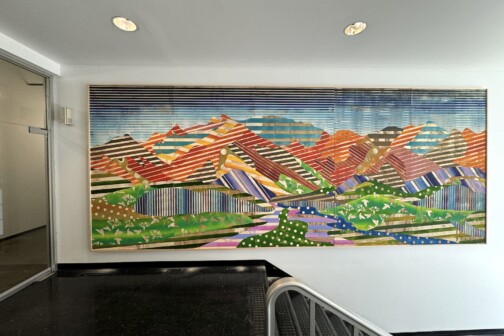
Image: James Michael Starr, Challenged, But Also Inspired, They Take Wing (2009), rotogravure newspaper images on panel, 9.75 x 28 inches
Dear Peter,
I think it’s very polite, very general in its specificity (or vice versa), and that every single item is so painfully obvious and familiar to me that I’m pretty sure I ate every thought on those pages for dinner last night and shat it all out in my toilet this morning. Like I do every 24 hours. So do you, and a lot of other people we know. So it bores me, and feels patronizing. But it’s not written for me, or at me, or you. It’s for everyone else in the “Metroplex”. Maybe it will all be totally novel to people, and really open things up.
But really?
I guess most Dallas people need a progressive and recognized group from New York f**king City to come down and lay it all out, in very plain language. Dallas people like to be validated by that kind of attention. They don’t want to hear what’s wrong with them, in critical language. Who does?
So I suppose Creative Time has achieved exactly what most hoped they would or could: they supplied the outside, authoritative voice, and built a clear “framework” for Dallas by typing out a set of ideas for a system that, if all the various moving parts are doing their jobs and working properly, should support a “world class” art scene.
And, in that sense: I should have gotten up earlier this morning but I didn’t, and I should have done one more load of laundry but decided to not waste the water that I will surely waste another way, and I still don’t have the money to get my car fixed, and my dog needs to go outside to pee right now, and why did I eat rice for the fourth night in a row, and I’m going to get started on building the gallery’s website from the ground up but I’ll let myself get distracted by that
Patti Smith book laying on the table, and no, I’m not gonna answer the phone today… . And I know none of that is ideal. I know it perfectly well.
Systems are like people, and our system is super f**king flawed. Bad habits, laziness, distractions, tight budgets and tight-fistedness, lack of ambition here vs too much ambition there, not nearly enough communication. Etc, of course. But don’t we all know that? What broken or underdeveloped part of the ideal system isn’t clear to anyone who cares?
Or are people really that blind to it? Maybe they are.
So, I guess Creative Time has to tell us: “Oh, honey, you have so much potential. If you just got a haircut, and got up a little earlier every day, and ran ten miles a week, ate better, and stopped taking drugs, and then of course became an amazing and tireless entrepreneur, you too could become rich and famous!”
P.S.
Sorry about the tone. You caught me on a Sunday.
I certainly respect and admire Creative Time, and I really do think they were tasked with something unwieldy and ephemeral. They did what they could, as responsibly as they could. (I think. I hope.) And I can see myself falling back on their report with my own bosses when I need to make a larger point about something I need to move the gallery forward. Backup helps, and this report may offer that to those of us who are fighting the good fight.
After reading all these art self help bromides from the Creative Times, I feel about the same way as I do listening to Wayne Dyer on PBS — kind of dull and bored in half-assed submission. I would wonder if they actually came to Dallas to come up with such trite generic suggestions, except that I did go to one dinner they had, which was astonishing in its lack of inclusion. (I’m inclined to comment on racial parity when there’s an egregious lack of it.) I noticed that this is a “prize report,” which means that SMU actually paid for this? So, I guess they went to lunch with a couple art “professionals” and then spent an hour or so coming up with “sharing meals,” “take agency,” “give collectors space” is this a parody of the real report? They can’t be that stupid, or maybe they figure we are.
Cultivating a larger collector base is the biggest challenge facing Dallas art galleries, along with changing the attitude that one can only find “real” art in NY. Some even declare “I only buy in Santa Fe” ( I am not kidding!). In a city obsessed with appearances, money and celebrity, Dallas is not a place where folks root for the underdog. Oak Cliff sure is and I suspect it is one of the many reasons why people are flocking to it. When galleries have greater financial support on a community level, more of our galleries can afford to participate in international art fairs, thus getting our local artists “out there.” (It’s hard to do any art fair with international audiences at under 20k a pop and this is just for the smaller satellite fairs, and many galleries consider themselves lucky just to break even).
The quandary seems to be this: How do you get collectors/museums in Dallas to buy work by local emerging and mid-career artists who are creating work on par with and/or more relevant than many “brand name” artists shown in NY? How do you get collectors to buy international artists shown at galleries in Dallas? It is not just a Dallas problem, even galleries in international art centers outside New York share the same problem.
The majority of my business stems from inquiries from the internet, and most are from out of state and many are located abroad. Surprisingly few sales occur with Dallas clients. But the few clients I DO have in Dallas “GET” the importance of buying and supporting local galleries and artists. It’s not rocket science to make this work, it just a decision, really, to become engaged and financially supportive of your community. Rather than all of this gnashing of teeth over the issue, perhaps the city should have some sort of cultural fund that helps galleries promote their artists to an international clientele. It seems to me the most direct route.
Input from the outside is most welcome. Kudos to SMU for commissioning Creative Time to listen to our arts community. We’ve spent a lot of money on the arts in Dallas (look downtown). But where are the street level artists? Creative Time points out that by supporting small and emerging orgs like La Reunion TX, all benefit and all survive in the long run. I appreciate the report so much I’m booking the local coordinator of the project, Leila Grothe to come talk on a panel discussion I’m coordinating for the NX35 Conferette loosely called ‘DFW is the New Black’. Save the date – March 11 at 11am in Denton. More details soon.
Funny how after all that time and money invested, Creative Time missed perhaps the largest flaw with the Dallas Arts community—that one of our most prestigious local universities would pay $25,000 for people from New York to diagnose our problems and write a report on the cultural performance of our city. Or more precisely pay for them to talk to all of us over margaritas and basically regurgitate what we have known and said for years.
Let me say that again. We PAID people to come down and tell us what’s wrong with us. As I write this I am sitting in NYC, surrounded by artists who are laughing in dismay and pity. The word ‘ridiculous’ is being frequently thrown around behind me.
Also is anyone really surprised by this wish list? What I am surprised about is how generic and universal it is. This could be used for the majority of cities, just replace a few pictures and names. But what were we really expecting from this? For them to report back that if we build one more new museum in the arts district that presto-chango everything will be amazing and we will have our own New York?
Now don’t misunderstand me. I agree with the list. Great list. Can I get a pony and a major museum along the lines of the Metropolitan or the Louvre while were at it? I also realize this was meant to generate a discussion amongst us all, it is. Yet isn’t that also a sign of larger problems? That it takes something like this for all of us to vocalize things we already know? Or worst yet, defend the status quo?
I’m glad to hear about SMU’s intent to host a summit on social practice in the visual arts. The Rachofsky House (led by Thomas Feulmer and Christina Rees) sponsored a series of roundtable discussions of small groups that broke down barriers and created greater understanding between various facets within the art community. This occurred shortly after Christina’s “state of the arts” critique of the Dallas art scene on Glass Tire. The roundtable discussions were by far one of the most promising initiatives that I have experienced while being in Dallas. I’d like to see something similar continue on a more permanent basis, perhaps SMU or one of the other universities can provide a think tank setting or safe environment to address the current and future social challenges facing Dallas’ art community. Overall, I think the Creative Time report is a good place to get started.

The creation of artistic interruptions can not solely rest on the shoulders of a meager few intrepid and impassioned young artists, but rather, like Chicago, they need to be staged by the very institutions that represent the impenetrable elitism of artistic activity: the museums, the operas, the symphonies, the theaters.
Top Stories
-
This Week's Visual Art, May 23-26: Dallas Art: A History in Fits and Starts
-
Weekender: Dallas Area Concerts for May 23-26
-
Interview: Alia Tavakolian on Her New Theater Collective and Sarah Kane, Plus The Theater You Should See This Weekend
-
The Cliburn Contender: What Does it Take to Prepare for the Cliburn International Piano Competition?