
Theater Review: With Night of the Iguana, Tennessee Williams Still Marvelous, Thundering

Author:
By
Post date:
February 14th, 2012 8:25am

Rating

G Y R

Location

Contemporary Theatre of Dallas 5601 Sears St. Dallas, TX 75206 Buy Tickets

Dates

Feb 10 thru Mar 4

There’s a scene in Night of the Iguana in which Lawrence Shannon (Ashley Wood), the mentally disturbed, ignominious minister at the center of the play, expounds upon his views of religion. He’s standing on the veranda of a ramshackle hotel in Mexico on the edge of a rainforest. A storm is brewing, low and deep. In the thunder, in the lightning and the rain, Shannon sees the master of the universe. He is wild, vengeful, refreshing, indiscriminate— and we could just as easily have been talking about Shannon himself, or perhaps even the playwright.

To be in the presence of such a master of words and mood as Tennessee Williams, executed well, is for me akin to Shannon standing in the rain at the end of the first act, marveling at an unfathomable god. Iguana, it is perhaps generally agreed, is the last of Williams’ commercially successful plays before his style unspooled in his later, little-produced works. It is no Streetcar Named Desire (or my personal favorite, The Glass Menagerie) but it is a great, seething, if somewhat unbalanced thing. His ability to mix outright poetry with a macabre, almost crude sense of humor rescues the play from the flowery, inaccessible realm, and it is to the credit of this excellent cast (and director René Moreno) that any instinct for the easy sentimentality that plagues lesser productions has been entirely excised. With some cuts to the original script, it finds a welcome home on the Contemporary Theatre’s stage (don’t be fooled, however, it is still long, clocking in around three hours).

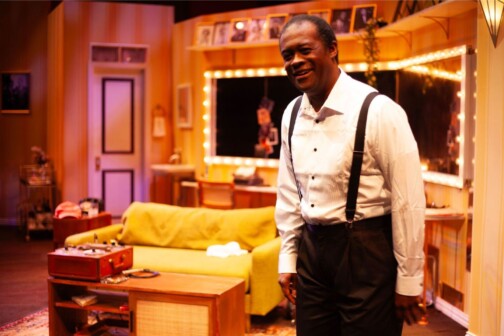
Though technically a comedy, and there are very funny moments, Iguana fits an introspective, melancholy mood perfectly— perhaps because all the characters seem so desperate themselves, alternately straining for something and stuck. The set, beautifully done by Rodney Dobbs, is both atmospheric and just the tiniest bit claustrophobic, evocative of a sweltering Mexican summer. Shannon, our erstwhile reverend, is also an erstwhile tour guide. He arrives at the Casa Verde Hotel seeking shelter from his own personal turmoil, something we learn he has done several times before. An old acquaintance, Maxine Faulk (Cindee Mayfield), recently widowed, lonely and lusty, owns the place and runs it with the help of Pancho and Pedro, her two “Mexican concubines,” as Shannon so delicately refers to them.

As it turns out, Shannon is also running from his “ladies,” a bus full of women from a Baptist college in Texas anxious to get on with their tour. He’s been accused of sleeping with one of his charges, an 16-year-old girl named Charlotte (Jessica Renee Russell) under the supervision of the irate Miss Judith Fellowes (Lorna Woodford). Of course, the accusations are true, but Shannon wouldn’t be Shannon if he wasn’t alternately admitting his conquest of the teenager and denying it. Wood plays him crazy-eyed and gravelly-voiced, muscling his way around the stage with the pent-up sort of energy reminiscent of a large, rather shouty jungle cat. When things get especially bad, he makes a manic dive for the large hammock, a refuge that eventually becomes his prison. His anxiety is palpable, and Woods delivers an honest, tense performance that walks the fine line between unhinged and over-the-top.

To further complicate matters, wandering artist Hannah Jelkes (Elizabeth Van Winkle) and her 97-year-old grandfather she calls Nonno (Terry Vandivort) show up broke and in need of place of stay. Shannon and the otherworldly Hannah (she’s a New England spinster, a calm, collected contrast to all the hotblooded Southerners running around) instantly affect a rare, compassionate understanding. She blasts a small hole in Shannon’s great wall of emotional insanity, realizing that he’s near the end of his rope. Their conversation, which takes up the majority of the second act and traverses the real and the fantastic realms of human experience and spirituality, reveals that she too is near the end of her tether. Her grandfather, supposedly the “world’s oldest living poet,” seems one well-composed verse away from death. Without him, she might find herself adrift, having devoted her life to traveling the world with him, painting caricatures while he recites his poems for money. She and Shannon are pitted against the same foes— the seeming random calamity of living, the desolation and depression that comes with it. The difference is, of course, is that Hannah chooses to go on rather than sink. Van Winkle’s measured tone belies a steely reserve, and she plays the potentially grating voice of reason well.

Though not the focus of the play, Cindee Mayfield’s nuanced portrayal of the widow Maxine Faulks is worth mentioning. Her softness is barely visible beneath her thick skin, cultivated over the course of a hard life, but Mayfield shows us how a brittle tongue and a biting wit can mask even the most rampant vulnerability and strongest yearning. Whatever solace the characters find or choose, there is never any doubt that it is temporary. The most we can ever hope for is someone who understands, a companion for the long sleepless nights when that solace eludes us or is no longer enough. Iguana provides a similar unsettling comfort— a recognition of a restlessness in the soul that more often than not points to a person for whom lasting happiness is simply not an option.


Leave a Comment

Comment

* required fields