
One the absolute highlights of my year last year, was participating in Pecha Kucha Dallas. Pecha Kucha (pronounced pechachka), Japanese for chit chat, is a lecture format that began in 2003 in Japan as a method for designers to use brevity to discuss their work. Now, the format has spread spread to include any innovative idea. The requirement is to talk about something you are knowledgeable about using 20 Power Point slides, timed at 20 seconds per slide. It seems like an unusual thing for a lawyer to say, but one of the values that I find increasingly powerful is brevity. There is something really powerful about being forced to remove extraneous words in order to make your point. Thus, the presentations in Pecha Kucha turn out to be particularly powerful. The organizers do a great job of getting a real cross section of ideas and people.
From its launch in Dallas, Pecha Kucha has been very popular. Last night’s event sold out quickly, so if you are interested in attending, keep your ears open and buy your ticket early. I know several people who wanted to attend and couldn’t. If you missed it, there should be some video from the event posted here: http://sparkforgood.wordpress.com/ And one note about the latest Pecha Kucha: all of the proceeds from the event are going towards Tsunami relief in Japan.
This year the event was at the historic Sons of Herman Hall (celebrating their 100th birthday, by the way). The evening had a few technical glitches, but the crowd was forgiving, as the event is just so darn inspiring it didn’t really matter. I love the Sons, and they are always willing to step up and use their fantastic facility for a worthy cause. Besides, they have Dos Equis Amber and Lager, cold and available. This keeps Mr. and Mrs. Holston happy and attentive.
First up was Harvey Lacey. I met Harvey Lacey a few years ago, when we had a very cordial disagreement about matters of faith on a local blog. Harvey is a 62 years old entrepreneur and a proud two tour Vietnam vet. I’ve always marveled at the creativity he displays in anything he designs and builds. His slides began with statistics about the fact that 827 million people live in slums. Harvey was inspired at a November 10, 2010 workshop in Dallas Texas featuring Ronald Omyonga, a Kenyan architect, to design a house that could be built affordably for people in the third world using inexpensive materials and that could be built low tech. In just six months, Harvey designed a metal press that could be built overseas and presses the cheapest materials available, non-recyclable plastic, into plastic blocks. The blocks are tied together with baling wire and then the entire house is stuccoed. He’s already built a prototype, which was displayed at SMU’s Living Village at Engineering & Humanity Week. The great thing about this project, inspired by Harvey’s philosophy is that it can create jobs in the third world, is its a simple design, which is where it shows its brilliance. It’s also a great example of what a single person can accomplish with an idea.
Sean Garman, a licensed architect and the Sustainable Design Leader for the Dallas office of Perkins+Will, discussed the problem of chemicals that fill our world. Learning that there are 258 chemicals that now show up in newborn’s blood, Garman decided that this sad fact should be taken into account when designing new buildings. (“First, do no harm,” he said.) So, Garman and his team developed what they call a Precautionary List of chemicals that should be avoided in construction projects. They then supplied that list for free to other designers and builders. The presentation offered a fascinating look at how design and health go hand in hand.
Michael Siegel, is an attorney who was inspired to create mobile kitchens which feather affordable and healthy food. He teamed up with chef Ben Hutchison, who has over fifteen years of kitchen experience in Dallas, including restaurants like Star Canyon, Routh Street, and most recently, Food Company. Together they started Green House Truck. He described the process of trying to decide where to put food trucks. He talked about getting food trucks into the area around the new arts district and how supportive the city had been with the concept. It’s a key to getting people out onto the street.
It’s not surprising that the most compelling images were from Kael Alford. Kael Alford is a documentary photographer, writer and journalist who has spent considerable time photographing in Iraq. She wanted to tell the stories of ordinary citizens of Iraq and the effect of the war on them, as opposed to the stories of our soldiers, and she actually showed shots of fighters with the Sadr Militia. Another noteworthy image showed a crude sign reading, “Take all Instructions, Deadly Force Authorized.” Alford’s plan is to return to Iraq to see if she can locate and photograph some of the people she shot back during combat.
One of my favorite presentation s was Andrew Sturm from Building Community Workshop. Andrew described the Workshop’s efforts to stimulate discussion about homelessness in a project on Martin Luther King’s Birthday. He quoted Dr. King “There is no deficit in human resources. There is a deficit in human will.” Andrew had the misfortune of getting up just after a lengthy technical delay in the program. He responded with good nature and humor and then launched into a great presentation about the 5750 project. As you may recall, volunteers spread artistic images of homeless people all over Dallas, illustrating the fact that there are 5,750 homeless people among us. This was a guerilla art project that might not have been “totally legal.’ Sturm also described the “housing first model,” which is an approach to combating homeless that argues that housing is the first social need that should be met for people. I left wanting to know more about what they are doing, and their website offers more info for those interested.
Perhaps the most enthusiastic presenter was Dr. Monica Evans from my alma mater, the University of Texas at Dallas. Dr. Evans is a hard core gamer, and explained how gaming should be used in education. She is using her students to design video games that could teach calculus in a fun and innovative way. Maybe If Dr Evans had taught me math, I wouldn’t break out in a cold sweat when I have to use a calculator.
Michael Precker has to have the most intriguing career paths around. In 1977 he joined The Associated Press in Israel as a correspondent, and was hired by The Dallas Morning News as its Middle East bureau chief in 1982. For the next six years he was based in Israel and reported from countries throughout the region, as well as southern Africa. In 1985 he was nominated for a Pulitzer Prize for his reporting from South Africa. Now he works for what he calls the “Mother Teresa of Strip Clubs.” Though he made it clear he had not been a customer before working there, Precker did speak very highly of the scholarships the club provides for their employees and the club’s community outreach efforts. The highlight of his presentation dealt with the humorous exchange the club has engaged in with Newt Gingrich’s group, American Solutions, who named owner Dawn Rizos as “Entrepreneur of the Year”, before rescinded the prize when they discovered Rizos ran a strip club.
Other presenters included Neeki Bey, a local musician who described his desire to teach music inspired by African traditions, as well as his travels to Ghana and Senegal, and Dustin Haisler, a former Assistant City Manager and Chief Information Officer (CIO) for the City of Manor, Texas. Haisler gave an interesting presentation on methods to engage citizen input in more creative ways than elections, and how to make participation in government fun for people, by creating portals for that input.
Every one of the presenters was interesting and to some extent inspiring, and being in a room full of people who are using their talents in creative and innovative ways always makes me feel good about our city and the world. I hope to see you there next time.
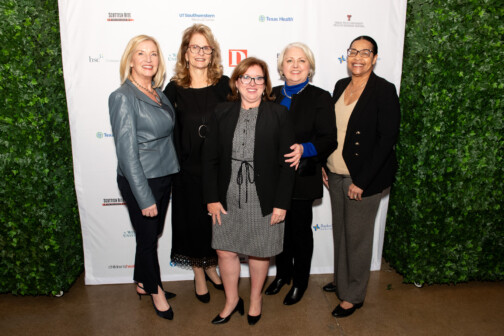
Photo by Dave Wilson via Pecha Kucha Dallas.

1 comment
Pretty sure it’s “peh-chak-cha,” not ” “pechachka.” Although I heard many people mispronounce it (your way) that night. There is no “chach” in the middle of it. Look at how it’s spelled, and Google for pronunciation guidance written by folks in other regions of the US. Texans are indeed pronouncing it the way you indicate, but it appears to be similar to Texans saying “nucular” instead of “nuclear.”