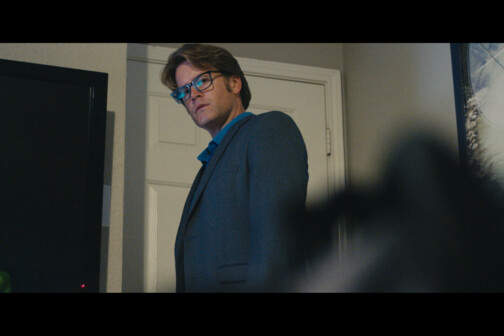

The Second Program’s Smaller Exhibition of Video Art Proves No Less Ambitious in Content

Author:
By
Post date:
August 2nd, 2010 11:11am

Rating

G Y R

Location

Conduit Gallery 1626 Hi Line Dr., Ste. C Dallas, TX 75207

Dates

Jul 31 thru Aug 28

The Second Program is a much smaller, less encompassing show than the massive, exuberant undertaking that launched the Dallas Video Festival’s video art spinoff two years ago. As curator Charles Dee Mitchell mentions in the notes that accompany the show that opened this past weekend at Conduit Gallery, the exhibition is meant to “provide viewers an engaging half hour at the gallery.” Having seen the work, that half hour the curator allots us is either a tease or clue.

For starters, the sum total length of the seven pieces included in the show exceeds nine hours of video. Don’t spend too much time in front of these works, Mitchell seems to say. We are not meant to watch Jason Rhoades’ six hour video loop of 8,000 digital images (Untitled, 2001) or Bill Viola’s 20 minute drama of facial expressions (Six Heads, 2000) from start to finish. It is the parenthetical viewing experience – viewers entering in and out of works in progress, experiencing the pieces without beginning, middle, or end – that give the works included here their intrigue and power.

Bill Viola, 'Six Heads,' 2000, single channel color video (9 minutes, 41 seconds)

The clearest example of this is Matthew Day Jackson’s Little Boy and Fat Man, 2009. The piece consists of two vertical flat screen televisions mounted on the wall next to each other, each showing one of the two atom bombs that fell on Japan in the closing days of World War II. They are falling in the air, through clouds, only we never see their release or impact. The impression is that they are either falling forever or perpetually suspended. Lingering in front of this image, we complete the story in our minds, knowing the bombs fell, the buildings burned, the people vanished. But in its narrative incompleteness, Jackson’s piece conveys a strange feeling, like we could somehow wish that these objects – structurally attractive in their bulbous brown steel – would never hit their target. After a few minutes, this fantasy becomes unbearable and we turn away.

John Gitleson’s Staring Contest, 2009, plays with a similar sense of timelessness and the unavoidable participation of the viewer in the piece. Two televisions are set on pedestals with the screens facing each other. Each shows a face staring forward, the two faces on the monitors participating in a staring contest that lasts 25 minutes – without a blink. The use of the two screens in the work creates some formally compelling moments. For one, it is a video that is reliant on the particular positioning of the objects containing the video – the televisions and the pedestals – embodying video with a kind of sculptural quality. Viewers also walk around and in between the contest, and as they do, the two staring faces’ eyes stay fixed on the viewer, like a video Mona Lisa. It is an illusion created by the video taped subjects staring directly into the lens of the camera. Though our initial assumption is that the two faces are staring at each other, we realize the eyes that seem to be looking out of the screens can only really be fixed on whoever happens to be looking back at them.

David Askevold’s Sixteen Candles, 1990-91 is also informed by participatory elements. The projector is set up hip high a good twenty feet from the wall the piece is projected on. The shadows of gallery visitors move about on the wall as they pass in the space between projector and image, obstructing (or entering into) Askevold’s candles, which flicker and float in circles, their flames only as bright as the wall’s white paint. Kristin Lucas’ whimsical VHS, 2010, isn’t a video at all, but rather a half melted video cassette sculpted in paraffin, calling attention to the idea of video as object as well as the ephemeral and evolving means of video transmission.

David Askevoid, 'Sixteen Candles,' 1990-91, single channel video with sound, 11 minutes.

Luke Murphy’s piece, The Longest Painting of Death, The Race Track (death on a Pale Horse c.1896), deals with this idea of the materiality of video head on. The piece is a projection of Albert Pinkham Ryder’s painting Death on a Pale Horse, only the image has been broken into a length of one mile of pixels that that are transversed in 2 minutes, 11.2 seconds, the average speed of the great thoroughbred champion Secretariat. The resulting image is a sequence of brightly colored lines that flicker and flocculate on the wall. Murphy seems to be calling our attention to the compositeness of the image and video’s capacity for breaking down image into elementary forms – until the space between the building blocks of image seem like the gap between protons and electrons. Curiously, the color of the works contains something of the mood of Ryder’s originally work, and in this way Murphy’s piece almost makes an art historical commentary – offering a bridge between the representational and abstract.

Murphy brakes down a single image into a great quantity of components. On the opposite wall, Jason Rhoades uses a great quantity of images to confound the viewer with a sense of how many individual perceptions make up the sum total of reality. His piece, Untitled, 2001, is so unassuming. A simple frame flashes in succession 8,000 digital images on a six hour loop. These images are ordinary and plain, like a photographer’s toss away photos that weren’t composed right or detail shots of rusted iron pieces of machinery that happened to catch the photographer’s eye. We look for meaning in montage, but no clear relationships emerge from the juxtaposition. What we are left with is a great heaping mass of tiny moments, insignificant views, actions, or objects otherwise forgotten. Like the randomized colorings of a Michael Craig Martin piece, it is almost impossible to ever really see the work in its entirety.

Rhoades is challenging our assumptions about the information images can contain. The piece seems inspired by Flickr or Facebook, which perpetuate the sense that all of life can be documented and that even the tiniest moments of our lives can be captured and shared. Rhoades’ work, however, is un-documentary photography. He bombards us with images in order to lead us to the perception that there is an infinite amount of visual information that will never be caught by the camera’s eye.

Main image: Erin Shirreff, Catch and Release, 2008, single channel video with sound, 3 minutes 30 seconds.


Leave a Comment

Comment

* required fields