
Something Intangible Finds Dramatic Fodder in the Volatile Life of a Re-Imagined Walt Disney

Author:
By
Post date:
July 1st, 2010 4:10pm

Rating

G Y R

Location

Circle Theatre 230 W. Fourth St. Fort Worth, TX 76102 Buy Tickets

Dates

Jun 24 thru Jul 24

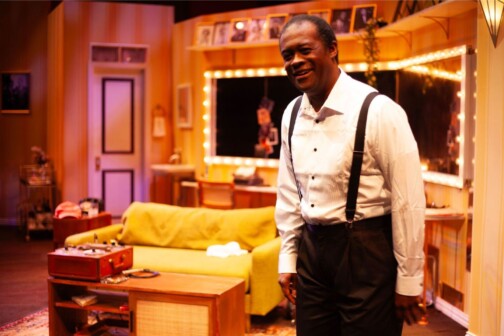
Like Sam Shepard’s True West, Bruce Graham’s new play at Fort Worth’s Circle Theatre explores the relationship between two brothers — one an artist, one not.  The play, directed by Matthew Gray, has so far been performed only in Philadelphia, and it comes here after winning several awards there. Based on Walt Disney and his brother Roy, the two leads are Tony  (Chamblee Ferguson), a philandering, drug-addicted insomniac genius, and Dale (Regan Adair), his pragmatic, good-hearted business manager brother. Together they form Tony Wiston Productions, just as Walt and Roy jointly owned Walt Disney.

The play takes place during the Golden Age of Hollywood, as Tony tries desperately to gain the funding and respect necessary to make Glorioso, which obviously stands in for Fantasia. Aside from these legally necessary substitutions, in which Mickey Mouse becomes Petey Pup, Snow White becomes The Ugly Duckling, and so on, everything I knew about the essence of Walt Disney was challenged by this play.

Graham paints him as a tyrant, who not only is unmarried (as opposed to the real-life Disney), but also seems doomed to a life of drinking and pill-popping. His life achieves occasional grace only through his art, which is presented here as something irrepressible, volcanic, and at times animalistic.

Chamblee Ferguson as Tony Wiston is magnificent, although his energy is a bit too wild at times. Compared to Regan Adair’s Dale, calm and suffering, Ferguson thrashed about the stage like Michael Richards on adrenaline, shouting and crying and laughing and breaking tennis racquets all in the name of his art. He was his best when he found Tony’s quieter moments, allowing a scene to build in energy, rather than trying to sustain chaos.

It is easy to fixate upon the thematic ambitions of the play, which revolve around Tony, but the show belongs to Tony’s brother, played with poise and gravitas by Adair. He is an actor of tremendous appeal, but in this piece he seemed desperate for a moment of real dramatic import. As it stands, Tony gets to rant and rave as Dale bears it all while timidly reporting back to his psychoanalyst. It is clear that Dale loves his brother, and makes up for his own lack of genius by being a stalwart executive, brother, father to his mentally-challenged son, and husband to his wife in their loveless marriage. The central question of the play is whether it is better to be an inartistic good man or a morally wayward genius.

The play’s form is thankfully not a sprawling chronicle. What its form is, however, is unclear. It is clever enough that Dale, so put-together and reasonable, would be seeing a psychoanalyst, but his sessions with Dr. Feldman (Nancy Sherrard) continue throughout the entire show on the right side of the stage, as Dale’s concurrent experiences with Tony are weaved into the left. Always watching the action, Sherrard never leaves the stage, which gets old quickly. Even though Graham devotes time and energy to developing her character, it all seems like time wasted. Despite a good performance, Sherrard is doing thankless work. The supporting cast also includes the charming Daniel Fredrick as a young animator, and Dennis Maher in a double role as a financial backer and a flamboyant German composer who collaborates with Tony on Glorioso. I couldn’t quite understand why Maher was double-cast, but maybe that’s just because he was so effective as the square banker while seeming all wrong in the role of the scoundrel von Meyerhoff.

The play’s title gets its name from a term of Tony’s— that an idea is never good until it has found that “something intangible” which makes it great. The play is engaging when it explores Tony’s artistic process, but there is something inherently “intangible” about this play. Disney is notorious for its strict copyright policies and fleet of lawyers who pound any soul who transgresses. Somehow, throughout all of the name changes and fictionalizing, the Disney secrecy looms over the play. As the founder and spokesman of an organization built on joy, morality, and imagination, it is understandable that Walt Disney would build a theme park with such huge walls. I kept expecting animated Secret Service men to burst into the play and shut it down for slander.

It’s perhaps understandable then that Graham would hypothesize and fictionalize so much, but it’s a hard balance to maintain. Making Dale his protagonist does a lot of the work for him, but in doing so, he takes a lot of time away from his play’s most compelling character. It would have been more effective if Dale had more to do, and something more tangible to work towards.

Indeed, Dale’s objective throughout the play seems to be to get Tony to simply appreciate him. It’s not strong enough. By eliminating the psychoanalyst and narrowing the dramatic action, Graham could have created a tenser, tighter portrait of two fascinating individuals, and given Dale more weight. As it is, Matthew Gray’s direction expertly brings out the energy and heart of the piece, but the suspense of the plot never materializes. It’s a truly enjoyable night in the theater, but I think Tony Wiston himself would have demanded more color.

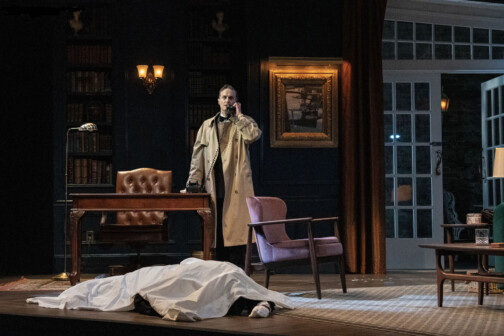
Photo: Dennis Maher, Regan Adair, and Chamblee Ferguson (Courtesy of Circle Theater)


Leave a Comment

Comment

* required fields